
When Seconds Count: How Well-Maintained Fire Alarms Save Lives
March 12, 2026
The Green Benefits of Switching to Solar Power
March 12, 2026
In today’s fast-paced business environment, companies are always on the lookout for strategies to reduce operational costs and enhance profitability. Among the various expenses that businesses incur, electricity bills often stand out as a significant and sometimes daunting cost. As energy prices continue to climb and the push for sustainable, eco-friendly practices intensifies, an increasing number of businesses are exploring innovative solutions to meet these challenges head-on. One of the most promising and effective solutions is solar energy.
Imagine transforming the abundant, free sunlight that bathes your building into a powerful, cost-saving asset. Solar energy isn’t just a trendy buzzword; it’s a practical, forward-thinking strategy that can dramatically lower your electricity expenses. By harnessing the power of the sun, companies can not only slash their utility bills but also make a substantial contribution to a healthier, more sustainable planet.
In this article, we’ll go deeper into the many ways solar energy can revolutionize your business’s approach to electricity consumption. From immediate cost savings and government incentives to long-term financial and environmental benefits, we’ll cover it all. Whether you’re a small startup or a large corporation, the insights shared here will illuminate the path to a brighter, more cost-efficient future powered by the sun.
-
The Basics of Solar Energy
Solar energy is harnessed from the sun’s rays using specialized equipment known as photovoltaic (PV) panels. These panels are the heart of any solar energy system, composed of numerous solar cells made from semiconductor materials like silicon. When sunlight strikes these solar cells, it triggers a fascinating process that converts light into electrical energy.
Here’s a closer look at how this process unfolds:
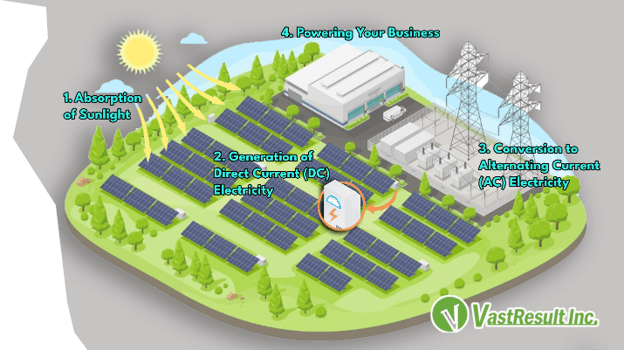
The Magic of Photovoltaic Panels
1. Absorption of Sunlight: The process begins when sunlight hits the surface of the photovoltaic panels. Each panel contains a grid of solar cells, which are designed to capture and absorb photons, the particles of light emitted by the sun.
2. Generation of Direct Current (DC) Electricity: Once the photons are absorbed, they excite electrons in the semiconductor material, causing them to break free from their atoms. This movement of electrons creates a flow of electric current within the solar cells. This current is known as direct current (DC) electricity, characterized by a unidirectional flow of electrons.
3. Conversion to Alternating Current (AC) Electricity: While DC electricity is generated efficiently by the solar panels, most businesses and households use alternating current (AC) electricity, which is more suitable for powering appliances and equipment. This is where the inverter comes into play. The inverter is a critical component of the solar energy system that converts DC electricity into AC electricity. It does this by rapidly switching the direction of the current, making it compatible with your business’s electrical infrastructure.
4. Powering Your Business: The converted AC electricity is then fed into your company’s electrical system, ready to be used to power lights, computers, machinery, and all other electrical devices. This seamless transition from sunlight to usable electricity is what makes solar energy such a versatile and effective power source.
Benefits Beyond the Basics
- Efficiency: Modern photovoltaic panels are designed to maximize the conversion of sunlight to electricity, even on cloudy days. Technological advancements have made solar panels more efficient and affordable, increasing their appeal to businesses of all sizes.
- Scalability: Solar energy systems can be scaled to meet the specific needs of your business. Whether you require a small installation to power a single office or a large array to support an entire manufacturing facility, solar energy can be tailored to fit your energy demands.
- Sustainability: By tapping into the inexhaustible energy of the sun, businesses can significantly reduce their dependence on fossil fuels. This not only helps lower electricity bills but also contributes to reducing greenhouse gas emissions and promoting a cleaner environment.
Understanding the basics of how solar energy works reveals its potential to transform the way businesses consume electricity. By converting the sun’s rays into a reliable and sustainable power source, companies can achieve significant cost savings and environmental benefits.
- Immediate Reduction in Electricity Bills
One of the most immediate and compelling benefits of installing solar panels is the significant reduction in electricity bills. By generating your own electricity on-site, your company can drastically cut its reliance on the traditional power grid. This means that a portion, or potentially all, of your energy needs can be met by the power you generate yourself. As a result, your dependence on electricity from the grid decreases, leading to immediate and ongoing savings on your utility bills. In many regions, businesses can take advantage of net metering policies, where any excess electricity produced by the solar panels can be sent back to the grid in exchange for credits on future electricity bills.
The exact amount your company can save by switching to solar energy depends on several factors, such as the size of your solar installation, the amount of sunlight your location receives, and your overall electricity consumption. Larger installations with more panels will naturally generate more electricity, leading to greater savings. Similarly, businesses located in regions with high solar irradiance will benefit from higher energy production. Furthermore, companies with high energy demands, like manufacturing plants or data centers, stand to gain the most from offsetting a large portion of their consumption with solar power.
Besides reducing electricity bills, solar energy also provides protection against rising energy costs. Traditional energy prices fluctuate due to factors like fuel prices and supply and demand. By generating your own electricity, your business becomes less vulnerable to these market dynamics, ensuring more predictable and stable energy costs. Additionally, modern high-efficiency solar panels can produce substantial amounts of electricity even in less sunny areas, maximizing your savings potential. Real-world examples, such as manufacturing companies and retail chains that have adopted solar energy, demonstrate significant financial benefits and enhanced sustainability, underscoring the value of investing in solar power for your business.
- Tax Incentives and Rebates
Governments worldwide are actively promoting the adoption of renewable energy sources by offering various incentives and rebates, and the Philippines is no exception. These financial benefits significantly reduce the initial investment cost of installing solar panels, making it more affordable for businesses to go green. In the Philippines, the government provides several incentives to encourage the use of solar energy. For instance, the Renewable Energy Act of 2008 offers tax exemptions and incentives such as duty-free importation of renewable energy equipment, tax holidays, and income tax deductions. Additionally, businesses can benefit from the Net Metering program, which allows them to sell excess electricity generated by their solar panels back to the grid. By taking advantage of these incentives, companies in the Philippines can lower the overall cost of transitioning to solar energy and significantly shorten the payback period, making it an even more attractive investment.
- Energy Independence and Predictable Costs
Electricity prices are often volatile, influenced by a range of factors such as supply and demand dynamics, fuel prices, and geopolitical events. This unpredictability can make it challenging for businesses to manage their operating expenses effectively. However, by investing in solar energy, your company can achieve a significant degree of energy independence. Once your solar panels are installed, you can generate your own electricity at a stable and predictable cost. This self-sufficiency insulates your business from the fluctuations of the energy market, providing a reliable energy source that helps you better forecast and control your expenses. In the long run, this stability not only simplifies budgeting and financial planning but also protects your company from future energy price hikes, ensuring a more secure and sustainable operational environment.
- Environmental Impact and Corporate Social Responsibility
Switching to solar energy goes beyond just saving money; it also provides significant environmental benefits. Traditional energy sources, such as coal and natural gas, are major contributors to greenhouse gas emissions and air pollution. These emissions have severe repercussions for both the environment and public health, leading to issues like global warming, respiratory problems, and ecological damage.
In contrast, solar energy is a clean and renewable resource that generates power without producing harmful emissions. Solar panels harness energy from the sun, which means they operate without releasing pollutants or greenhouse gases into the atmosphere. By adopting solar energy, your company actively reduces its carbon footprint and contributes to a cleaner, healthier environment. This proactive approach not only helps in combating climate change but also aligns with global sustainability efforts.
Moreover, committing to solar energy can enhance your brand’s reputation. In today’s market, demonstrating a commitment to environmental stewardship resonates strongly with consumers and stakeholders who prioritize sustainability. By showcasing your dedication to green practices, you can attract environmentally conscious customers and build stronger relationships with partners who value corporate responsibility. This alignment with the growing demand for corporate responsibility and eco-friendly practices can further strengthen your company’s market position, making it a leader in both business and environmental integrity.
- Long-Term Investment and Increased Property Value
While the initial cost of installing solar panels can be substantial, it’s crucial to view this expenditure as a long-term investment. Solar panels typically have a lifespan of 25 to 30 years, meaning they will continue to provide benefits and generate savings over an extended period. During this time, they can lead to significant reductions in electricity bills, as they produce power from the sun at no additional cost beyond the initial setup.
Moreover, solar energy systems usually require minimal maintenance, which helps to further reduce ongoing costs. The durability and low maintenance needs of solar panels ensure that once they are installed, they can continue to operate efficiently with only occasional upkeep, allowing you to enjoy long-term savings with minimal effort.
In addition to financial benefits, properties with solar installations are often viewed as more attractive to potential buyers and tenants. The presence of a solar energy system can increase the value of your business premises, making them more appealing in the real estate market. This added value can be a significant advantage, enhancing your property’s marketability and potentially yielding a higher return on investment.
Conclusion
Solar energy offers an abundance of benefits for businesses seeking to reduce their electricity bills and embrace sustainable practices. From the very beginning, solar energy provides immediate cost savings and valuable tax incentives, which can significantly offset the initial investment. Additionally, it enables energy independence, allowing your company to generate its own electricity and avoid the volatility of traditional energy prices. The environmental impact of switching to solar is also profound, as it helps reduce your carbon footprint and contributes to a cleaner, healthier planet.
By investing in solar energy, your company can make a substantial step towards a more sustainable and financially secure future. The advantages are clear: substantial savings, reduced reliance on the grid, and a positive environmental impact. Now is the time to explore solar energy solutions and join the growing number of businesses that are not only improving their bottom line but also making a meaningful contribution to environmental stewardship. Embrace solar energy today and position your business at the forefront of both economic and ecological progress.